
How to Use Seedance 2.0 for AI Video (Without a CapCut Subscription)
Seedance 2.0 generates video with synchronized audio from $0.07/sec at 480p. Compare CapCut Pro costs, see what the model can do, and how it runs on Slates Credits.
Seedance 2.0 is ByteDance's latest AI video model, and it does something no other model does right now: it generates synchronized audio and video in a single pass. Sound effects land on cue. Dialogue matches lip movements. Background music syncs to visual beats. All of that happens automatically, with no separate audio step.
Most people know Seedance through CapCut Pro, where clips draw from a monthly pool of 1,200 AI points on a $19.99/month plan. But you can access the same model through API providers from $0.07 per second at 480p. A 10-second draft costs $0.70, and 720p is $1.50, with no pool to run out of.
Here's everything you need to know about what Seedance 2.0 can do, what it costs, and how it compares to the other models available right now.
What Is Seedance 2.0 and Who Made It?
Seedance 2.0 is an AI video generation model built by ByteDance (the company behind TikTok and CapCut). It launched on February 10, 2026, and hit the #1 spot on the Artificial Analysis Video Arena leaderboard within weeks, beating Veo 3, Sora 2, and Runway Gen-4.5 in user preference rankings.
What sets it apart from every other video model is the unified audio-video architecture. Most models generate silent video, then you add audio separately. Seedance generates both together. The audio isn't just slapped on top. It's environment-aware. A whisper in a large room gets reverb. A door slam sounds different in a hallway than in a bedroom. Music syncs to visual cuts automatically.
It also accepts more input types than any other model. Through its "Omni Reference" mode, you can feed it up to 9 images, 3 video clips, and 3 audio clips alongside your text prompt. No other model accepts that many simultaneous inputs.
- ›Text-to-video: Describe what you want, get video with matching audio
- ›First and last frame: Control the start and end of the clip with reference images
- ›Omni Reference: Combine multiple images, video clips, and audio files as references in one generation
- ›Lip sync: Native support for 8+ languages with accurate mouth movement
- ›Multi-shot generation: Multiple camera cuts within a single 15-second clip
How Much Does Seedance 2.0 Cost?
A 10-second Seedance 2.0 Standard clip costs $1.00 through the API. On CapCut Pro the same generation comes out of a 1,200-point monthly pool, and on Dreamina (ByteDance's own creative platform) Seedance 2.0 is priced from about $0.046 per generated second on the monthly promo plan, with credit caps and a monthly fee on top.
Cost Estimator
Here are the per-second published API rates for Seedance:
| Model | Per Second | 5s Clip | 10s Clip | 15s Clip |
|---|---|---|---|---|
| Seedance 2.0 Fast | $0.08 | $0.40 | $0.80 | $1.20 |
| Seedance 2.0 Standard | $0.10 | $0.50 | $1.00 | $1.50 |
| Kling V3.0 Standard (no audio) | $0.084 | $0.42 | $0.84 | $1.26 |
| Kling V3.0 Standard (with audio) | $0.126 | $0.63 | $1.26 | $1.89 |
| Veo 3.1 Fast (with audio) | $0.15 | $0.75 | $1.20 | N/A (8s max) |
Audio is always included with Seedance. There's no toggle and no surcharge. That makes the real comparison Seedance at $0.08-0.10/second vs Kling with audio at $0.126/second vs Veo Fast with audio at $0.15/second. Seedance is the cheapest option when you need video with sound.
Higgsfield sells Seedance 2.0 through credit-capped plans. Plus is $59/month ($47 annual) for 1,200 credits and Ultra is $129/month ($99 annual) for 3,000, and each Seedance generation eats through credits fast. The raw provider rate for Seedance depends on resolution: $0.07 a second at 480p, $0.15 at 720p, $0.37 at 1080p and $0.78 at native 4K. Through Slates, you get Seedance on Slates Credits, with no monthly subscription, no credit caps, and no expiring allowances.
50 ten-second Seedance Fast clips = $40/month in API costs. On CapCut Pro the same volume runs against a 1,200-point monthly allowance, and when it is gone you buy more points or wait until next month. With API access, there are no credit caps and no monthly limits.
What about CapCut Pro?
CapCut Pro runs $19.99/month ($179.99/year) and gives you access to Seedance 2.0 through 1,200 AI points a month, with extra points sold from $4.99 per 100. A clip's cost depends on its length and resolution, and the points expire on the plan's clock.
If you're generating more than a handful of clips per week, the subscription model gets expensive fast. API access at $0.08/second doesn't have monthly caps, expiring credits, or resolution restrictions. For a full breakdown of how subscription pricing compares to pay-per-use across all models, see AI Video Generator Pricing: Subscription vs Pay-Per-Use.
What Can Seedance 2.0 Actually Do?
Seedance generates video clips from 4 to 15 seconds long at native 2K resolution, 24fps. It supports six aspect ratios: 21:9, 16:9, 4:3, 1:1, 3:4, and 9:16. Every generation includes synchronized audio at no extra cost.
The model has two speed tiers. Fast is cheaper ($0.08/second) and generates in about 30-40 seconds for a 5-second clip. Standard costs $0.10/second with higher quality output, but takes 60-120 seconds.
The three generation modes
Text-to-video is the simplest. Describe your scene, and Seedance generates the video with matching audio. You can specify camera movements, lighting, and even multi-shot sequences with timing cues in your prompt.
First and last frame gives you more control. Upload a reference image for the start frame, end frame, or both, and Seedance generates the motion between them. This is useful for product animations, scene transitions, and maintaining visual consistency across a sequence.
Omni Reference is where Seedance really separates itself. You can combine up to 9 reference images, 3 video clips (15 seconds total), and 3 audio clips (15 seconds total) alongside your text prompt. Want a specific character wearing a specific outfit in a specific location with a specific backing track? Feed all of those as references. No other model accepts this many simultaneous inputs.
Native audio co-generation
This is the feature that makes Seedance genuinely different. The model generates audio and video together in one pass, not as separate steps stitched together afterward.
That means:
- ›Sound effects land precisely when the visual event happens
- ›Dialogue gets lip-synced automatically in 8+ languages
- ›Background music matches the mood and timing of visual cuts
- ›Environmental acoustics adapt to the scene (reverb in a cathedral, dry sound in a small room)
For comparison, Kling 3.0 charges extra for audio ($0.042/second surcharge). Veo 3.1 includes audio but charges roughly double for it. Seedance includes it at the base rate, always.

How Does Seedance 2.0 Compare to Kling 3.0 and Veo 3.1?
Seedance is the cheapest model when you need audio, Kling gives you the most hands-on camera control, and Veo is the only one that outputs 4K. They're built for different shots. Here's a quick comparison across the things that actually matter for production work.
| Feature | Seedance 2.0 | Kling 3.0 | Veo 3.1 |
|---|---|---|---|
| Max duration | 15 seconds | 15 seconds | 8 seconds |
| Max resolution | Native 2K | 1080p | 4K |
| Audio included | Always, no extra cost | +$0.042/s surcharge | Included through Google |
| Audio type | Full scene audio (SFX + dialogue + music) | SFX + dialogue | SFX + dialogue |
| Reference inputs | 9 images + 3 video + 3 audio | Text + single image | Up to 3 reference images |
| Camera controls | Prompt-based | 6-axis manual controls | Prompt-based |
| Multi-shot | Yes (prompt-based cuts) | Yes (AI Director, up to 6 cuts) | No |
| Lip sync | Native, 8+ languages | Via separate lip sync mode | No native lip sync |
| Per-second cost (with audio) | $0.08-0.10 | $0.126 | $0.10-0.40 |
When to pick Seedance: You need video with audio, you want to use multiple reference files, or you're doing high-volume work where the lower per-second cost adds up. It's also the best choice for music-driven content and product animations.
When to pick Kling: You need precise camera controls (6-axis), multi-character dialogue (Omni mode), or the AI Director for scripted multi-shot sequences. Kling gives you more hands-on control over exactly what happens in the frame.
When to pick Veo: You need 4K output. That's it, really. Veo is the only model that generates at 4K natively. If your project delivers in 4K, Veo is the only option.
For a deeper breakdown, see Kling vs Veo vs Sora: Which AI Video Model Should You Use?.
The right answer for most projects is to mix models. Use Seedance for clips that need audio, Kling for shots that need precise camera work, and Veo when you need 4K. Tools like Slates let you switch between all three in the same project.
What Are Seedance 2.0's Limitations?
The real limitations are clip length, identity drift between generations, and a warm color bias. Content filtering used to top this list, and it is the thing most write-ups still lead with, so it is worth being precise about what it does and does not block.
Content filtering on ByteDance's own endpoint is aggressive, and that is not the end of the story. After cease-and-desist letters from Disney, Paramount, and Netflix, ByteDance deployed heavy restrictions on its first-party API: it refuses most human face references, celebrity names, trademarked logos, and certain artistic styles. That is where the "Seedance can't do characters" reputation comes from.
In Slates it is not the whole picture. A generation goes to a different provider depending on what is in your reference, and you choose it in the model picker rather than discovering it mid-render. Faceless work takes the first-party route, which is the cheapest and the default. An AI-generated character's face takes a relaxed route that accepts it, shown as its own picker row at its own higher price. A real person's face, with their consent, takes a separate premium route that asks you to confirm you hold the rights to that likeness first. Public figures and celebrities fail everywhere, on every model. So character work on Seedance is a routing decision, not a wall.
15-second cap per generation on Seedance 2.0. There's an "extend" feature on consumer platforms (Dreamina, CapCut), but it often causes character inconsistency between the original clip and the extension. For clean longer sequences, generate separate clips and edit them together. Slates also ships Seedance 2.5, which runs a single 30-second take at 480p, 720p or 1080p. It has no native 4K and costs more than 2.0 at every resolution the two share, so it is a second seat rather than an upgrade: reach for it when length is the point, and stay on 2.0 for 4K or for the same resolution at a lower price.
Identity drift across clips. Characters can shift slightly between separate generations. Faces change subtly, clothing details drift. Every AI video model has this problem right now, but keep it in mind for multi-shot projects.
Runs on Slates Credits. In Slates, Seedance 2.0 runs on Slates Credits, the same as every other model in the app.
Warm color bias. Some users report a consistent warm tint affecting skin tones and neutral scenes. Not a dealbreaker, but something to correct in post if color accuracy matters.
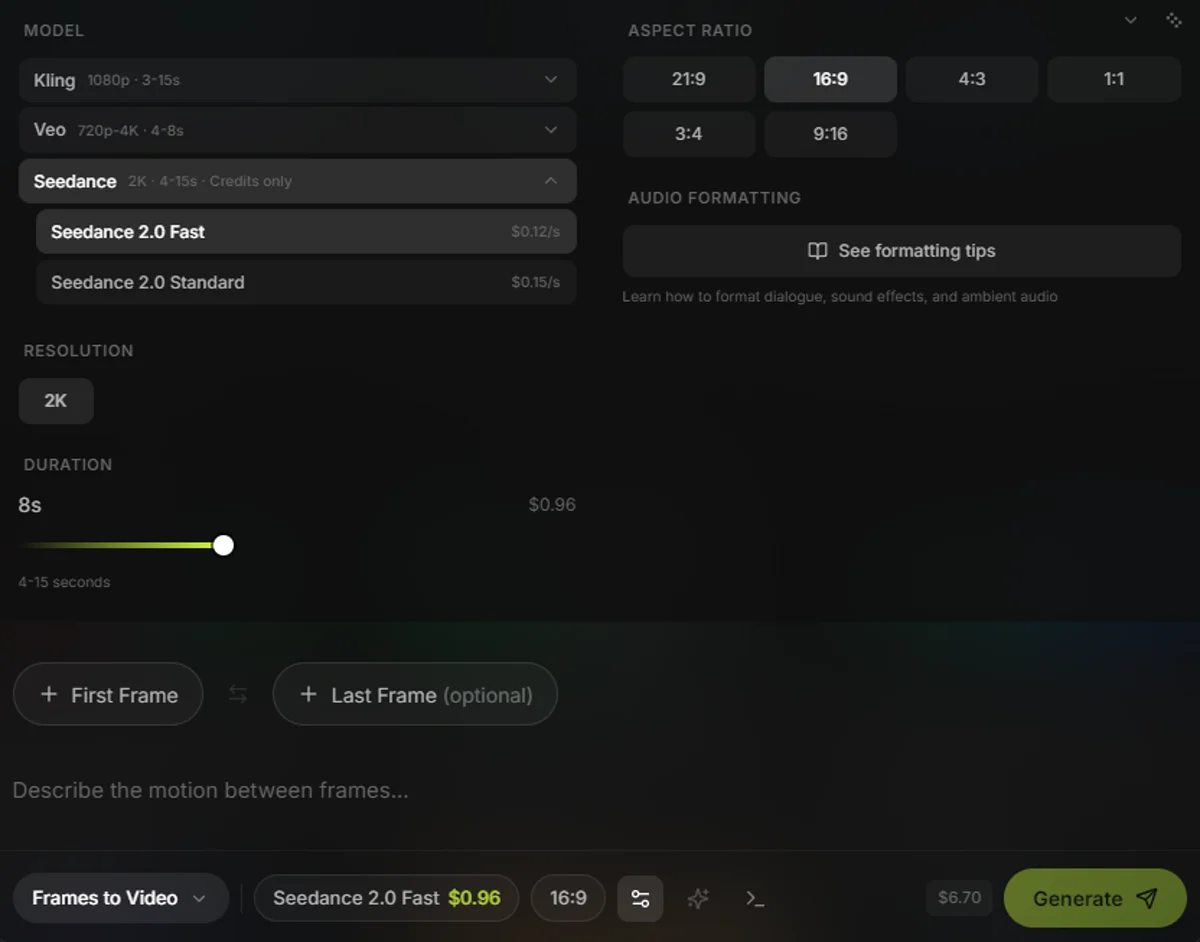
How Do You Use Seedance 2.0 in Slates?
Seedance 2.0 is available in Slates as of April 2026. Download the app, select Seedance from the model dropdown, choose Fast or Standard, set your duration and aspect ratio, and generate. Check pricing for current credit rates.
Both Seedance variants are available through Slates Credits. Audio is always included. No extra settings needed. You pick your mode (text-to-video, first/last frame, or omni reference), write your prompt, and hit generate.
The cost estimator above shows exactly what each generation costs. Select "Seedance 2.0 Fast" or "Seedance 2.0 Standard" from the dropdown and adjust the clip length to see your per-clip and monthly costs.
Seedance 2.0 output generated in Slates. Audio included automatically.
Frequently Asked Questions
They're good at different things. Seedance is better for audio-inclusive video, high-volume work at lower cost, and multi-reference workflows. Kling is better for precise camera controls, multi-character dialogue, and projects where you need granular direction over what happens in each frame. Most production workflows benefit from using both.
Yes. Seedance 2.0 is available through API providers at $0.08-0.10 per second. Tools like Slates give you access to Seedance through Credits without needing a CapCut or Dreamina subscription. No monthly fee, no credit caps, no expiring allowances.
Yes. Audio generation is built into the model architecture. Every Seedance clip includes synchronized sound effects, dialogue, and ambient audio. There's no way to disable it and no extra charge for it. If you don't want the audio, just mute it in your editor.
Anything from 480p to native 4K. Kling and Veo 3.1 both reach 4K as well, so resolution is no longer what separates them; per-second price at each rung is. For most social media, web, and presentation use cases, 720p or 1080p is more than enough.
Yes, if the generation goes to a route that accepts it. ByteDance added aggressive content filters after legal pressure from Disney, Paramount, Netflix, and Sony over deepfake concerns, and its own first-party endpoint refuses most human face references. That is where the reputation comes from. In Slates an AI-generated character's face routes to a relaxed provider that accepts it, shown as its own row in the model picker at its own price, and a consented real person routes to a separate premium route behind a rights confirmation. Public figures and celebrities fail on every route, everywhere.
Last updated: April 9, 2026